Ron Hanks 2A Record: My Complete NRA Questionnaire
NRA-PVF National Rifle Association of America Political Victory Fund 11250 Waples Mill Road Fairfax, VA 22030-7400 Phone: (202) 651-2560
2026 U.S. House Candidate Questionnaire
Name: Ron Hanks Campaign Name: HanksForColorado Address: PO Box 117 City & State: Penrose, Colorado — Zip Code: 81240 Office Sought: US House: Colorado Congressional District 3 — District: 3 — Party: Republican Campaign Phone: 719 352 5264 Website: HanksForColorado.com Email: HanksForColorado@proton.me
Please check the letter corresponding to the answer of your choice:
1. All fifty states and the District of Columbia currently recognize a right to carry concealed firearms for self-defense, whether by the routine issuance of licenses to eligible applicants or otherwise. Forty states recognize licenses from other states to varying degrees. Twenty-nine states grant full legal recognition to out-of-state concealed carry licensees or other lawful concealed carriers. Yet in a small handful of states, otherwise law-abiding American travelers are subject to prosecution and lengthy mandatory prison time for failing to realize that their out-of-state concealed carry credentials are not recognized in those states. The NRA therefore supports concealed carry reciprocity legislation to ensure lawful concealed carriers are granted recognition when traveling from one state to the next, subject to each state's rules of behavior for concealed carry.
✅ A. I agree with the NRA and would support concealed carry reciprocity legislation.
☐ B. I disagree with the NRA and would not support such legislation.
2. Under current federal law, retail sales of firearms by holders of a Federal Firearms License (FFL) require a background check, while firearm transfers between private parties living in the same state do not. In all cases, however, a person may not transfer a gun if he or she has reason to believe the recipient is prohibited from having it. Gun control advocates want to change this to mandate background checks every time a firearm changes hands, even among friends and relatives. Such a law could lead to jail time and heavy fines for a person who simply loans, gives or sells a firearm to a life-long friend without going through an FFL. The NRA objects to requiring background checks for lawful private party sales or transfers that do not amount to business activity aimed at predominantly earning a profit, which the Justice Department has admitted can only be enforced through creation of a federal firearm registry.
✅ A. I agree with the NRA that commercial transactions are different than private transfers between two law-abiding citizens, and I will not vote for legislation that seeks to require federal government approval for private firearm transfers.
☐ B. I disagree with the NRA and support legislation to require federal government approval for private firearm transfers.
3. In 1994, President Bill Clinton signed a 10-year ban on the importation and manufacture for sale to private persons of nearly 200 models of semi-automatic firearms, including the iconic AR-15, and ammunition magazines that could hold more than 10 rounds. Federal studies determined the ban had no measurable effect on crime, and it was allowed to expire in September 2004. Gun control proponents continue to pursue legislation for expanded bans on popular semi-automatic firearms and standard capacity magazines owned by millions of law-abiding Americans. The NRA opposes such legislation.
✅ A. I agree with the NRA and would vote against legislation to ban commonly owned semi-automatic firearms and standard capacity magazines.
☐ B. I disagree with the NRA and support legislation to ban commonly owned semi-automatic firearms and standard capacity magazines.
4. During the late 1990s, dozens of big city mayors, backed by gun control groups, filed lawsuits against American firearms manufacturers, falsely claiming they were responsible for the criminal misuse of firearms by third parties. Their goal was to either bankrupt the industry or force industry members to "voluntarily" adopt gun control via agreements between parties. To stop this abuse, Congress passed, and President George W. Bush signed into law the Protection of Lawful Commerce in Arms Act (PLCAA). Without this law, this coordinated effort against America's firearms manufacturers would have succeeded. President Biden and other gun control advocates have recently renewed their efforts to repeal or weaken the PLCAA.
✅ A. I agree with the NRA and would not vote to repeal or weaken the PLCAA.
☐ B. I disagree with the NRA and support the repeal of the PLCAA.
5. The lawful use of sound suppressors (known in federal law as "silencers") is increasingly popular among shooters and hunters. Possession and use of suppressors is lawful in 42 states, with 41 of those permitting their use for hunting. Suppressors protect the hearing of shooters and those in proximity to firearm discharge. In 2025, Congress repealed the tax on suppressors formerly imposed under the National Firearms Act (NFA) but left intact the law's application and registration requirements. The NRA supports legislation to remove suppressors from the NFA, in which case they would be treated as ordinary firearms under the Gun Control Act.
✅ A. I agree with the NRA and would vote for legislation to remove suppressors from the NFA.
☐ B. I disagree with the NRA and oppose such legislation.
6. The lawful use of so-called short-barreled firearms is increasingly popular among shooters and hunters, and sales of these items are expected to grow since the $200 tax was repealed in 2025. However, the application and registration requirements still remain under the NFA. The NRA supports legislation to remove short-barreled firearms from the NFA, in which case they would be treated as ordinary firearms under the Gun Control Act.
✅ A. I agree with the NRA and would vote for legislation to remove short-barreled firearms from the NFA.
☐ B. I disagree with the NRA and oppose such legislation.
7. Government funded "gun safety research" has been openly biased since the 1990s. Centers for Disease Control (CDC) officials have unabashedly supported gun bans, used CDC funds to advocate for strict gun control, and poured millions of taxpayer dollars into funding "research" that was in fact advocacy — medical journal hit pieces against gun ownership. Congress investigated this practice, and, since 1997, it has prohibited the CDC from using taxpayer funds "to advocate or promote gun control." Nevertheless, this funding was revived under the Obama and Biden administrations, with predictably similar results. NRA believes the CDC and other components of HHS have no business using tax dollars in an effort to convince Americans that firearms are incompatible with "public health."
✅ A. I agree with the NRA and support strictly construing the language of the CDC rider to prevent publicly funded gun control advocacy.
☐ B. I disagree with the NRA and would repeal the prohibition against the CDC using taxpayer funds to advocate or promote gun control.
8. The National Instant Criminal Background Check System (NICS) only prohibits the purchase of firearms based on objective disqualifiers. Due process requires the government to substantiate firearms purchase denials with reliable documentation. A "safety-valve" provision in current law enforces this requirement by allowing (not mandating) an FFL to proceed with a sale after 3-business days (or after 10 business days, in the case of some sales to those aged 18 to 20) if the FBI still has not denied the sale (illegal possession, of course, remains actionable by law enforcement). Gun control advocates want to repeal this safety-valve, which would effectively grant the FBI discretion to deny sales indefinitely.
✅ A. I agree with the NRA that the safety-valve provision is an important civil rights safeguard and should not be repealed or extended.
☐ B. I disagree with the NRA and think the FBI should have the discretion to leave NICS checks open, effectively denying transfers without proof of ineligibility.
9. Federal law prohibits the transfer of a firearm to an individual who has been "adjudicated as a mental defective." The Department of Veterans Affairs (VA) has, since the 1990s, erroneously applied this language to beneficiaries who have had a fiduciary appointed to administer benefits on their behalf. This administrative process considers only financial competency, not an individual's propensity for violent or dangerous behavior. Nevertheless, the VA illegally reported hundreds of thousands of beneficiaries to NICS as prohibited persons, until Congress defunded this practice with year-to-year appropriations riders beginning in 2024. NRA supports legislation to permanently disallow VA's practice and to authorize such reporting only when a judge has determined the beneficiary to be a danger to self or others.
✅ A. I agree with the NRA and would vote to pass legislation that would prohibit the VA from stripping veterans of their Second Amendment rights without due process and relevant findings.
☐ B. I disagree with the NRA and believe that the VA is right to report these veterans to the federal gun ban database.
10. Since 1998, a NICS check that includes disqualifying events from all states has been conducted by the FBI for retail handgun, rifle and shotgun sales. However, an outdated 1968 federal law still bans interstate handgun sales, other than between licensed dealers. Because of this law, a private individual can purchase a rifle or shotgun, but not a handgun, from a licensed dealer outside of the individual's state of residence. The NRA supports legislation to update federal law by allowing a law-abiding individual to purchase a handgun from a licensed dealer in any state, provided that the dealer complies with all requirements of federal law and the laws of the state where the dealer is located and of the purchaser's state of residence.
✅ A. I agree with the NRA and would vote for legislation to allow interstate handgun sales.
☐ B. I disagree with the NRA and oppose such legislation.
11. Lack of access is one of the main reasons for the decline in hunting, fishing, trapping and recreational shooting. The NRA believes sportsmen should have increased access to federally owned or administered lands for hunting, fishing, trapping and recreational shooting where these activities can safely be conducted.
✅ A. I agree with the NRA and would support such access.
☐ B. I disagree with the NRA and would oppose such access.
12. The modern trend in criminal justice is to reintegrate offenders into society by restoring their rights after they have satisfied their sentences. Gun control proponents want to go in the opposite direction with Second Amendment rights by opposing restoration and seeking lifetime prohibitions for an expanding list of misdemeanor convictions. Misdemeanor court proceedings have fewer legal procedural protections, and convictions do not result in the permanent loss of other civil rights. These expanded misdemeanor prohibitions for firearms possession could also apply retroactively to convictions that predated the prohibitions. The NRA opposes expanding misdemeanor firearm disqualifications.
✅ A. I agree with the NRA and would oppose any attempt to expand the scope of misdemeanor convictions that would lead to a permanent loss of Second Amendment rights.
☐ B. I disagree with the NRA and support expanding the scope of misdemeanor convictions used as a basis for a permanent loss of Second Amendment rights.
13. Federal law prohibits the possession of firearms by convicted felons and other "prohibited persons." Federal law also provides a process by which such persons can apply to the Attorney General to seek restoration of their gun rights — a process commonly referred to as "relief from disabilities." In the past, such relief was routinely granted to people who had committed non-violent crimes many years earlier and had not committed any additional crimes. Beginning in 1992, congressional appropriations riders prevented the ATF from processing these applications, leaving applicants no effective recourse to restore their Second Amendment rights. However, the Justice Department recently published a proposed rule to reinstate the process via the Office of the Pardon Attorney to restore rights to individuals who are not "likely to act in a manner dangerous to public safety." The NRA supports a process by which non-violent prohibited persons can apply to have their rights restored after appropriate screening.
✅ A. I agree with the NRA and support reestablishing a process to provide "relief from federal firearm disabilities."
☐ B. I disagree with the NRA and oppose reestablishing a process to provide "relief from federal firearm disabilities."
14. A foundational principle of the American justice system is to ensure that an individual receives judicial due process — including notice of the relevant accusations, opportunity to appear at a hearing before a neutral judge, to present evidence in his or her favor, and access to legal representation — before being deprived of life, liberty, or property. Nevertheless, "red flag" laws in the states allow judges to strip individuals of their Second Amendment rights and to order their firearms seized with little or no opportunity to contest, including via ex parte orders. The NRA opposes red flag laws as lacking due process and as non-responsive to any underlying circumstances that may require treatment or stabilization.
✅ A. I agree with the NRA and would oppose the enactment of a federal red flag law or federal funding of state red flag laws.
☐ B. I disagree with the NRA and would support enactment of a federal red flag law and/or federal funding of red flag laws in the states.
15. Legislation has been introduced that would ban persons on the so-called "Terrorist Watchlist" — which is comprised of several secret federal lists — from purchasing or possessing firearms. The listing process is highly subjective, highly secretive, and affords virtually no due process or opportunity to challenge mistakes. The watchlist currently contains millions of names and is fraught with errors; for example, current and former members of Congress and children as young as two years old have been included on the watchlist. The NRA opposes the use of secret government lists to deny Americans their fundamental Second Amendment rights without due process.
✅ A. I agree with the NRA that secret government lists should not be used to deny Second Amendment rights and will oppose any legislation that doesn't provide full due process protections.
☐ B. I disagree with the NRA and support legislation authorizing the use of secret government lists to deny Second Amendment rights, including legislation that lacks due process protections.
16. Anti-gun efforts are increasingly targeting access to ammunition, with proposals to ban mail order sales, require background checks and point-of-sale record-keeping, eliminate traditional lead bullets and shot, ration purchases, and even restrict the amount of ammunition that may be possessed at one time. Congress, with ATF's approval, phased out a requirement for ammunition purchase records as burdensome and unhelpful to law enforcement. Most of these proposals, meanwhile, would target law-abiding people who are making a point of maintaining a high level of proficiency and training with their firearms.
✅ A. I agree with the NRA and would oppose any attempts to restrict or further regulate the purchase or possession of firearm ammunition.
☐ B. I disagree with the NRA and think ammunition is too readily available and should be further regulated.
17. Firearm owner licensing is a system in which private citizens are required to obtain permission from a government agency to buy and/or possess a firearm. Licensing requirements may include fingerprinting, expensive and arbitrary safety or proficiency training, fees, and an explanation as to why the firearm "is needed." The NRA opposes firearm owner licensing as a violation of Americans' constitutional rights, an invasion of their privacy, and a waste of resources, as criminals already obtain firearms without complying with existing legal formalities.
✅ A. I agree with the NRA and would vote against federal firearm owner licensing.
☐ B. I disagree with the NRA and would support new federal licensing for firearm owners.
18. Firearm registration is a system in which a government agency maintains immediately accessible records of specific firearms owned by individual citizens. Current federal law prohibits the creation of a federal firearms registration system (other than the existing registration requirements for machine guns, "short-barreled" rifles and shotgons, and other NFA firearms). The NRA opposes firearm registration — which has facilitated gun bans and confiscation in the United States (in California and New York City) and in other countries (including Australia, Canada, and England) — as an unconstitutional and unnecessary measure that will be ignored by criminals.
✅ A. I agree with the NRA and would vote against expanding federal firearm registration.
☐ B. I disagree with the NRA and support legislation expanding federal firearm registration.
19. Gun control proponents want taxpayers to fund research and development of so called "smart guns" — i.e., firearms that incorporate technology that would allow them to operate only by authorized users — with an eye towards making such technology mandatory when it is significantly developed. The NRA opposes public funding for "smart gun" research and development, as well as legal mandates that such technology be incorporated into firearm design and believes that firearm designs should be market driven.
✅ A. I agree with the NRA and would vote against attempts to use taxpayer funds to develop "smart gun" technology or to enact legal mandates for its use.
☐ B. I disagree with the NRA and believe the development of this technology should be publicly funded, and its use should be mandatory.
20. Under current law, commercial manufacturing of firearms requires an FFL. Federal law does not prohibit law-abiding individuals from making a firearm for personal use. However, anti-gun activists hyperbolically refer to these personal firearms as "ghost guns" and have used confusion about emerging 3D printing technology to stoke concerns that these firearms are undetectable or otherwise unusually dangerous. In fact, manufacturing or possessing an undetectable firearm has been illegal since 1988, and personally made guns, including those incorporating 3D printed parts, are subject to all existing laws governing other firearms. Therefore, the NRA opposes further restrictions on firearms manufactured for personal use.
✅ A. I agree with the NRA and would oppose any attempt to expand federal law to further regulate manufacturing a firearm for personal use.
☐ B. I disagree with the NRA and believe in banning personal firearms manufacturing.
21. Federal law requires gun manufacturers, importers, and dealers to respond promptly to ATF requests for assistance in tracing firearms in the course of bona fide criminal investigations. ATF's longstanding practice has been to hold such trace requests as confidential law enforcement information. Anti-gun groups and municipalities, however, have sought access to this information for use in lawsuits against firearm industry members or for misleading propaganda about "crime guns." Congress has passed appropriations riders that prevent the disclosure of firearms trace data for anything except law enforcement purposes or aggregate analysis. Major law enforcement organizations support these protections because disclosure could negatively impact ongoing criminal investigations, lead to the exposure of confidential informants, and mislead the public.
✅ A. I agree with the NRA and would vote to ensure that firearms trace data be kept limited to bona fide criminal investigations only.
☐ B. I disagree with the NRA and would vote to repeal the prohibition on public disclosure of firearms trace data.
22. A dedicated segment of firearms enthusiasts have chosen to legally purchase rifles that fire certain .50-caliber cartridges. The .50-caliber Browning cartridge, for example, is used in highly technical long-range target shooting competitions. Other .50-caliber cartridge designs have existed for well over a century and have been used throughout that time for hunting. Despite the reality that these rifles are almost never used in crime because of their considerable size, weight, and costliness, anti-gun activists want to impose severe new restrictions on these guns.
✅ A. I agree with the NRA and would vote against new restrictions on ownership of .50-caliber rifles by law-abiding Americans.
☐ B. I disagree with the NRA and support restrictions on .50-caliber rifles.
23. Do you agree with the U.S. Supreme Court's decisions in District of Columbia v. Heller, McDonald v. City of Chicago, and NYSRPA V. Bruen? These decisions underscore that the Second Amendment to the U.S. Constitution guarantees the fundamental, individual right to keep and bear arms for self-defense and other lawful purposes and that firearm laws must fit within the text, history, and tradition of our nation's firearm regulations.
✅ A. Yes.
☐ B. No. Please explain: _______________
24. Are you a member of the National Rifle Association, or of any other Second Amendment related organization(s)? If so, please list organization(s) and latest year of membership:
Yes. GOA — current.
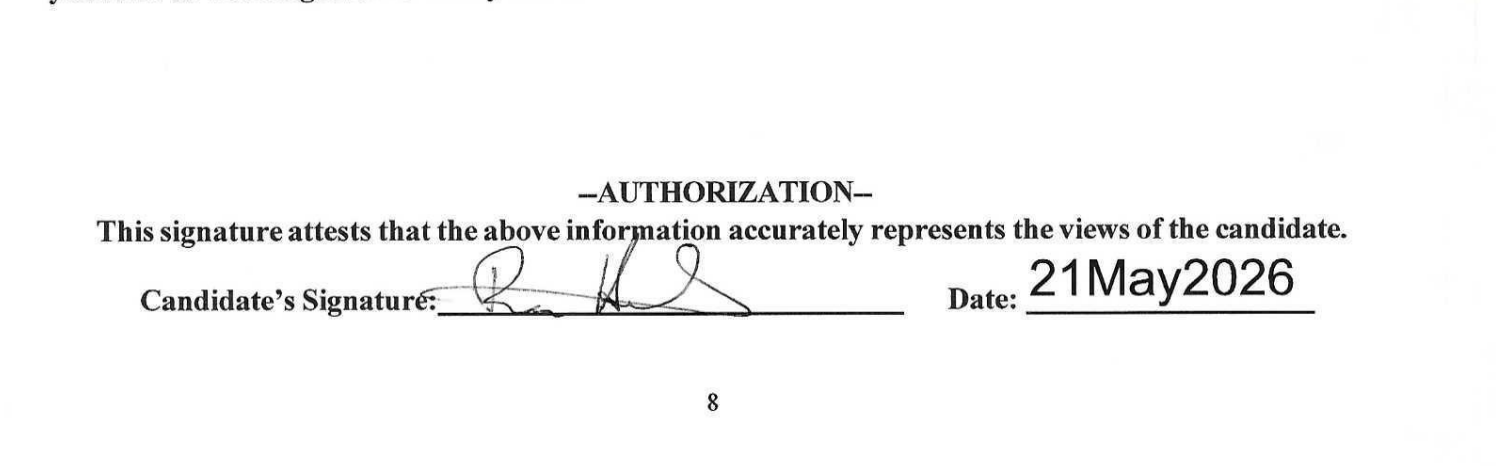
Additional Comments (Page 8):
THANK YOU!
This is a very good questionnaire, and I applaud the NRA/PVF for producing it.
My record in the Colorado House will show I put forth legislation for Constitutional Carry, and I will join or draft similar legislation in the US House of Representatives. I drafted legislation to repeal Colorado's magazine capacity limits, and I co-sponsored a bill to allow the use of deadly force at businesses. (HB22-1033, HB21-1070, HB22-1105, respectively). I will join or draft any legislation that protects our Second Amendment.
I have been an NRA member for much of my adult life. I have been "A" rated by NRA in the past, and, of course, "AQ" rated before I was elected. However, glitches have prevented endorsements and ratings from being consistent across hard copy magazines and online. It has been damaging to our mutual efforts to secure our 2nd Amendment Rights, and out of frustration after the last miscue, I did not renew my membership. I hope those miscues were simply errors from a previous era and that I will not experience them again.
In my political efforts after my 32 years of military service, it has been revealing to learn how little integrity there is in our political system. We have the best system of government in the world, yet the lies that spring forth from DC, Big Lobbyists, and directly from our representatives are something to be very concerned about. Indeed, my opponent and his network of lobbyists, which include the House Speaker's PAC, branded me Anti-2A despite my demonstrable record to the contrary. Lies can easily win in Washington, and the number of constituents who reached out in 2024 and expressed their disappointment after believing the lies that I was a "gun-grabber", was concerning. I am running again in 2026 to fight these Lies and those who spread them.
I have grave concerns for the future of our nation if LIARS can convince the populace that Wrong is Right, Left is Right, that surrendering Privacy and Rights will offer us Security, and that Government should be involved in all things, not limited by the U.S. Constitution. I believe we have a limited opportunity to secure this nation in Liberty, and I wage this battle to help President Trump and the America First agenda in his final two years in office. To read more, please go to:
HanksForColorado.com
I look forward to working vigorously with the NRA when elected to US Congress. Thank you to the members of the NRA for their commitment to doing what is right for our nation, and God Bless America in our 250th year. Let us work together for many more.